Interest rates kicked into their best levels in over a month in response to the big political shift on election night. Stocks moved sharply higher, bonds improved, yields moved lower, and oil dropped significantly. Let’s break down what happened, why the markets initially celebrated the election results, and look at the important economic news ahead.
"Ch-ch-ch-ch-changes, Turn and face the strange" Changes by David Bowie.
Election Day Market Movement
Election Day delivered a giant political shift, and the financial markets wasted no time responding.
The next morning, stocks and bond prices opened sharply higher, which pushed yields lower, and oil fell by more than $8. The 10-year Note touched its lowest level since early September, helping mortgage rates improve along with it. So, why did markets initially celebrate?
One key reason is the potential for stalemate in Washington, D.C. With the balance of power split, it becomes less likely that we see enormous new spending packages over the next two years.
This is good news for the bond market as bonds hate more bonds.
Why? Because large spending packages can mean more Treasury issuance, more bonds for the market to absorb, and potentially more upward pressure on yields. Less spending can ease some of that pressure, which helps bonds.
Oil, as it always does with interest rates, also played an important role. The sharp drop in oil helped the 10-year Note move lower by several basis points and took mortgage rates along for the ride. The likely reason is that markets may be pricing in more urgency to wrap up the conflict with Iran more quickly.
Lower oil prices can help reduce inflation fears, and that is exactly what the bond market likes to see.
The bottom line? The market liked the potential for less spending, less inflation pressure, lower oil prices, and a more bond-friendly backdrop.
Good News Is Good News
We also received some early labor market numbers, and they showed a labor market that still has some underlying strength.
ADP private payrolls came in below expectations, which helped support the idea that the labor market is not overheating.
At the same time, the JOLTS report showed more job openings than forecast, while the quits ratio ticked up to its highest level in over a year.
Are higher quit ratios good news? You bet they are.
A higher quits ratio is a good sign for the labor market because people are generally more willing to quit their jobs when they feel confident they can find another one. In other words, workers are still showing confidence beneath the surface.
This is one of those moments where good news can still be good news. The labor market is not falling apart, but it is also not showing the kind of overheating that would force rates higher.
5.00%
The 10-year Treasury Note yield, an important benchmark for mortgage rates, recently moved beneath the key psychological level of 5.00% after climbing to a 2026 high near 5.36%.
This is good news for rates, because in the financial markets, resistance can become support, and support can become resistance.
Previously, 5.00% may have felt about as good as rates could get. Now that the 10-year Note has moved beneath 5.00%, that level could become an area where rates struggle to move meaningfully higher.
Oil and Volatility
The other important piece is oil. The sharp decline in oil could help remove some volatility from the market. Lower volatility can help mortgage spreads narrow, meaning the spread between the 10-year Note and 30-year mortgage rates could move closer to more historical norms.
That matters because mortgage rates can improve even without another major decline in the 10-year Note. If spreads narrow, mortgage rates can get additional help.
The takeaway: The move beneath 5.00% is important. If the 10-year Note can stay beneath this level, mortgage rates may have room for additional improvement.
30-Year Mortgage Rates and 10-Year Note
30-Year Fixed Mortgage Rate
- Rate: 7.18%
- Change from Previous Week: down from 7.24%
- Change Year-over-Year: up from 6.22%
10-Year Treasury Note Yield
- Yield: recently moved beneath 5.00%
- Recent high: near 5.36%
- Key level to watch: 5.00%
The spread between the 10-year Note and 30-year mortgage rates remains an important story. If market volatility continues to decline and mortgage spreads narrow toward more historical norms, mortgage rates could see additional improvement even without another meaningful move lower in the 10-year Note.
Looking Ahead
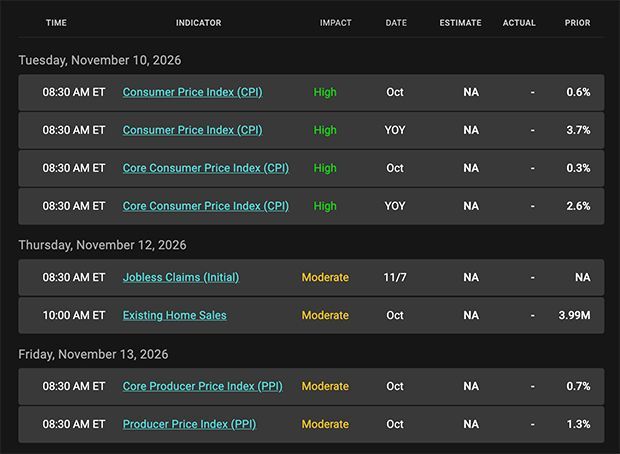
Next week brings another big week for the financial markets.
The high impact events include:
CPI: The October Consumer Price Index will give the markets another important look at inflation and whether price pressures continue to move lower.
PPI: The October Producer Price Index will show inflation pressures at the wholesale level and can influence expectations for future consumer inflation.
Existing Home Sales: This report will provide a fresh look at housing activity and how higher borrowing costs continue to impact buyers and sellers.
Jobless Claims: Weekly unemployment claims remain an important read on the strength of the labor market and whether companies are beginning to slow hiring or increase layoffs.
Treasury Auctions: The bond market will have to absorb another round of Treasury supply, including 3-year, 10-year, and 30-year auctions. The longer-duration auctions will be especially important, with the highly watched 10-year Note and 30-year Bond auctions giving us a fresh read on investor demand.
Bond Market Closure: The bond market will be closed on Wednesday, November 11, 2026, in observance of Veterans Day.
The bottom line? Rates improved nicely after the election, but the next test comes quickly. Inflation data, Treasury supply, and investor demand will all help determine whether this recent improvement in mortgage rates has more room to run.
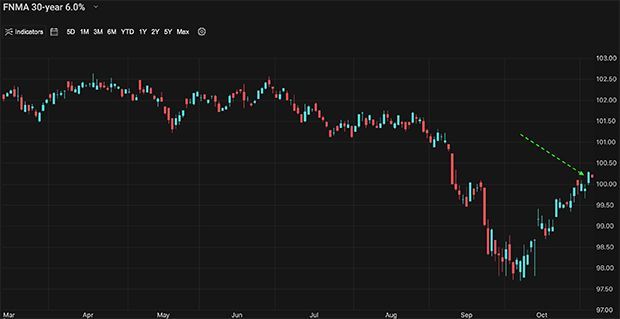
Mortgage Market Guide Candlestick Chart
Each candle represents one day of trading. As mortgage bond prices move higher, rates move lower. You can see on the right side of the chart how mortgage bond prices have improved sharply after the election, helping push interest rates to their best levels in over a month.
The recent move higher in mortgage bonds is very encouraging. The next important test is whether prices can hold these gains and build on them as the market digests inflation data, Treasury auctions and ongoing developments in Iran.
Chart: Fannie Mae 30-Year 6.0% Coupon (Friday, November 6, 2026)
Economic Calendar for the Week of November 9 - 13
The material contained in this newsletter has been prepared by an independent third-party provider. The content is provided for use by real estate, financial services and other professionals only and is not intended for consumer distribution. The material provided is for informational and educational purposes only and should not be construed as investment and/or mortgage advice. Although the material is deemed to be accurate and reliable, there is no guarantee it is without errors.